
超级管理员 Knowledge
Food & Packaging Cleanroom FFUs: Practical Guide
How food, hygienic packaging, and clean-engineering projects select FFUs—coverage, coated housings, HEPA grades, OEM lead times, and large-hall module choices.
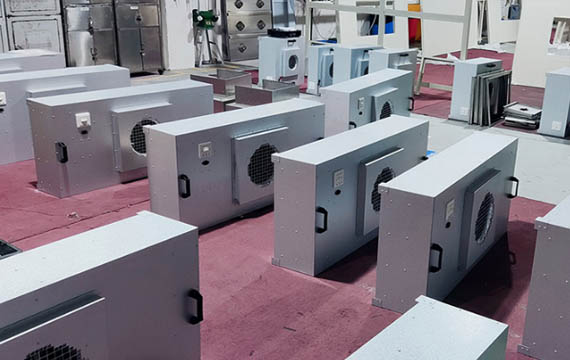
What FFUs do food, packaging, and clean-engineering projects actually need?
These projects usually need right-sized laminar FFU coverage over open product or hygienic process zones, corrosion-resistant serviceable housings, HEPA grades matched to mid-range ISO targets, and predictable OEM lead times — not default ULPA carpets or fab-only control complexity.
Food primary packaging, beverage filling surrounds, nutraceutical packing, medical-adjacent packaging, and general “clean engineering” renovations share a practical goal: stabilize airborne particles where product or critical surfaces are exposed. Classification language still references ISO 14644-1 when a class is claimed. This article is equipment-selection guidance — not a food-safety certification, HACCP plan, or regulatory approval.
ISO 14644-1 defines cleanroom air cleanliness classes by maximum allowable airborne particle concentrations.
— ISO 14644-1:2015
Many packaging halls land nearer ISO mid-range densities (typically ISO 7-like 25–40% coverage as a starting point) with tighter pockets only where owners specify them.
Map the plant before you map the SKU
Separate high-care open-product zones from secondary packing, palletizing, and technical corridors — then assign FFU density and materials per zone.
| Zone type (typical language) | FFU design emphasis | Module starter |
|---|---|---|
| Open product / primary packaging | Coverage over expose points, cleanable hardware | 1175×1175 / 1175×875 |
| Hygienic filling surrounds | Stable supply + documented HEPA | 1175-class or 615 as grid dictates |
| Secondary packing / inspection | Moderate coverage, noise-aware if manned | Mixed |
| Technical mezzanine / AHU adjacency | Service access, not cosmetic density | Fewer units / different family |
| Brownfield modular inserts | 600 grid compatibility | 615×615 |
A full ISO 5 semiconductor carpet over a dry secondary packing warehouse is usually the wrong clean-engineering answer.
Large halls favor 1175-class modules; upgrades favor 615×615
Wide packaging halls often shortlist 1175×1175 (high airflow on ~1200 grids) or 1175×875 (rectangular modules + group control); brownfield 600×600 inserts shortlist 615×615.
| Building cue | Shortlist | Senter platform cue |
|---|---|---|
| Wide 1200-class hall | 1175×1175 | DC 400, ≥2000 m³/h class conversation |
| Rectangular bays + multi-zone speeds | 1175×875 | DC 400 + group-control readiness |
| Narrower metric modules | 1175×575 | DC 310 |
| 600×600 modular clean upgrade | 615×615 | Internal rotor + 400 Al impeller; 1.0 mm housing |
Food plants often retrofit under existing trusses — cabinet height and lift plans matter as much as catalog airflow.
Housing and hygiene-adjacent materials (without overclaiming)
Specify coated steel FFU housings (aluminized zinc / galvanized) at appropriate gauge — commonly ~0.8 mm on 1175-class modules and ~1.0 mm on 615×615 — and confirm compatibility with actual cleaning chemicals and humidity; escalate materials only when the environment demands it.
| Environment note | Housing direction |
|---|---|
| Dry packaging hall | Standard AZ/GI coated steel usually appropriate |
| Higher humidity / washdown adjacency | Confirm coatings; may need special review |
| Aggressive caustic/acid cleaners on the box | Do not assume standard FFU coat survives — document chemicals |
| OEM color standards | Follow coating SOP so paint does not create corrosion paths |
FFUs are ceiling modules, not always washdown equipment. If your hygienic design requires stainless process machinery, that does not automatically force stainless FFU housings everywhere — but it does force an explicit materials decision in the URS.
Filtration: HEPA pragmatism for packaging risk
Most food/packaging FFU projects succeed on HEPA H13/H14 written in EN 1822 language; use ULPA only for documented ultra-tight requirements — after proving final ΔP against the fan curve.
EN 1822 classifies HEPA/ULPA filters by MPPS performance.
— EN 1822
H13 (≥99.95% at MPPS per EN 1822 classification) is a common choice for broader electronics/food mid-range applications — a useful starting point for packaging halls, still subject to the site’s contamination control plan.
Loading reality: flour dust, fibers, and cardboard fines can load prefiltration and change effective ΔP faster than a quiet electronics room. Monitor differential pressure; do not rely only on calendar change-outs.
Multi-shift energy and simple, reliable controls
Food and packaging plants frequently run multi-shift — EC/DC platforms and zone control pay back when fleets are large and continuous — a typical estimate is about 40–50% energy savings versus AC and 2–3 year payback for 50+ units running 16+ h/day, depending on duty-point watts and local tariff.
Control pattern that fits many plants
- Start with zone 0–10 V on small rooms
- Move to Modbus/group control when halls exceed tens of units
- Use setback on non-critical areas when quality systems allow
- Define comms-loss fail behavior (hold / safe % / stop)
Occupied packing lines also care about acoustics; EC units are usually quieter at comparable airflow because they can run slower — specify measured dB(A) at a stated distance and duty point.
OEM/ODM and lead-time predictability
Integrators and brand owners in packaging often need private-label FFUs with stable spare parts — prefer manufacturers that own motor-to-complete-unit stacks so interface risk and documentation stay in one place.
Typical OEM asks in this segment:
- Logo / color / carton marks
- Connector standardization across countries
- Certificate mapping (CE/RoHS; ISO 9001 process signal; 3C where applicable)
- Spare fan/filter kits with clear SKUs
- Reasonable MOQ for phased line expansions
Quantity sanity check for packaging halls
Apply coverage/ACH math, then force the number onto real ceiling geometry around conveyors, lights, and fire services.
| Planning input | Typical use here |
|---|---|
| ISO mid-range coverage ~25–40% | Broad packaging halls (when ISO 7-like) |
| Higher localized coverage | Open product / high-care pockets |
| Duty-point m³/h | Always — include final filter ΔP |
| Margin 10–25% | Layout + loading contingency |
RFQ block for food, packaging & clean engineering
Zone map: open product / primary pack / secondary / corridor ___
ISO target or owner cleanliness basis: ___
Grid & free height: ___
Modules: 1175×1175 / 1175×875 / 1175×575 / 615×615 ___
Airflow @ initial & final ΔP: ___
Filter grade (EN 1822): H13 / H14 / ULPA ___
Cleaning chemicals / humidity notes: ___
Housing: AZ/GI; 0.8 / 1.0 mm; special coat? ___
Controls: local / 0–10V / Modbus; setback ___
Noise limit (manned lines): ___ dB(A) @ ___ m
OEM branding + target lead time / MOQ: ___
Quantity + CAD: ___
Conclusion
For food, hygienic packaging, and general clean engineering, specify FFUs that deliver stable mid-range clean airflow, maintainable coated housings, honest HEPA duty points, and OEM-ready documentation — using 1175-class modules for wide halls and 615×615 for modular upgrades — without importing semiconductor ULPA carpets by default.
Keep ISO 14644-1 / EN 1822 language when classes and filters are claimed, demand operating-point data (airflow at final filter pressure drop, noise, voltage, control), and shortlist hardware on senter-motor.com. Send zone maps and cleaning-environment notes for an engineered recommendation that fits real plants.
References
- ISO 14644-1:2015 — Classification of air cleanliness by particle concentration
- EN 1822 — High efficiency air filters (EPA, HEPA and ULPA)
Surround
Electronics & Optical Cleanroom FFU Airflow Design
Design FFU airflow for electronics and optics cleanrooms—600×600 grids, noise-aware EC control, HEPA selection, and module shortlists for EMS, PCB, and display lines.
Motor Core to Complete FFU: Why Integration Matters
Why buying FFU motors and complete units from one source reduces duty-point risk—vertical integration benefits, OEM implications, and what to verify at the factory.