
超级管理员 Fans & Motors
FFU Noise Control: dB Specs That Actually Matter
How to specify cleanroom FFU noise—dB distance, duty-point speed, EC vs AC, filter loading, and inquiry language that prevents “quiet on paper, loud on site.”
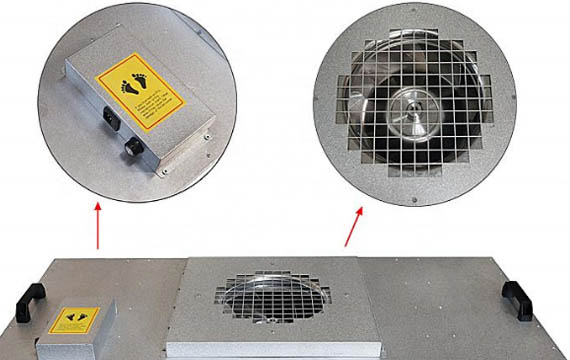
What FFU noise spec actually matters?
The noise number that matters is A-weighted sound level at a defined distance and duty point (airflow + filter pressure drop + fan speed)—not the quietest free-air brochure figure measured under ideal lab conditions.
Cleanroom FFUs run for years above people’s heads. If the inquiry only says “low noise” or “≤55 dB” with no distance, no filter state, and no speed, suppliers can all “comply” while the installed array still fails EH&S review. Treat acoustics as part of the same duty-point discipline used for airflow and static pressure.
A complete FFU inquiry states airflow, final filter pressure drop, cabinet height, noise target, voltage, and control interface—noise belongs on that list as a full requirement, not a footnote.
Why cleanroom FFU noise is a systems problem
An FFU’s perceived noise is the sum of fan aerodynamics, motor drive, housing resonance, filter resistance (which forces speed), ceiling coupling, and how many units run nearby—not a single motor SKU trait.
| Contributor | What raises dB(A) | What lowers dB(A) |
|---|---|---|
| Fan speed | All dials max at commissioning | Balanced speed for ISO target |
| Filter pressure drop | Dirty/tight pack → higher RPM | Correct grade + timely change-out |
| Motor tech | Coarse AC taps | EC/DC fine speed control |
| Housing | Thin panels / leaks / rattle | Adequate gauge, sealed joints |
| Array effect | Dozens of units in one bay | Zoning + night setback |
| Install | Rigid short-circuit to structure | Proper grid isolation practices |
ISO particle limits still come from ISO 14644-1. Acoustics must be solved without violating those limits—quiet-but-under-flow is not a win.
ISO 14644-1 classifies air cleanliness by airborne particle concentration limits at the work plane.
— ISO 14644-1:2015
EC vs AC: what to expect from FFU sound
EC/DC FFUs are usually quieter at the same airflow because they can run at the minimum speed that still meets the duty, instead of sitting on a coarse AC tap. How much quieter depends on the module, filter, and speed—so specify measured dB(A) at a stated distance and duty point rather than relying on a generic EC-vs-AC figure.
How to read any supplier’s noise figure
- Distance: a value at 0.3 m and a value at 1.5 m are not comparable; no distance means no usable number.
- Duty point: the figure should state airflow and the filter pressure drop it was measured against.
- Filter state: clean (initial) and loaded (final) packs demand different speeds—ask which one applies.
- Speed: record the fan speed command; a low dB value at reduced speed says nothing about full-duty noise.
- Energy and noise often improve together when speed drops: EC/DC motors offer higher efficiency, especially at part load, and a typical estimate is about 40–50% energy savings versus AC on comparable duty, depending on duty-point watts.
Inquiry language that prevents “quiet on paper, loud on site”
Write noise as a testable acceptance clause: metric, weighting, distance, height, filter state, airflow, and pass/fail method.
You can paste this into specifications:
Sound pressure level shall not exceed ___ dB(A)
when measured at ___ m horizontally from the FFU centerline
(and/or ___ m below filter face), in a defined acoustic environment,
with the unit delivering ___ m³/h at filter pressure drop = ___ Pa
(initial / final — state which), at the corresponding fan speed command.
Supplier shall state instrument class and whether value is for a single unit
or a representative array.
| Field | Why it matters |
|---|---|
| dB(A) | Matches human hearing weighting used in most EH&S reviews |
| Distance | 0.3 m vs 1.0 m vs 1.5 m changes everything |
| Filter pressure drop | Dirty/tight filters force higher speed → higher noise |
| Airflow | Same dB at half airflow is not comparable |
| Single vs array | 20 units are not one unit plus magic; report method |
| Speed command | 0–10 V / Modbus setpoint must be recorded |
If a datasheet omits distance or pressure drop, treat the number as marketing, not acceptance criteria.
Filter grade and noise: the hidden coupling
Stepping from HEPA H13 to H14/ULPA without fan headroom often shows up first as noise, because operators raise speed to chase lost airflow.
Keep filter language aligned with EN 1822 (MPPS-based HEPA/ULPA classes). Every tighter pack is a static-pressure request.
EN 1822 classifies EPA/HEPA/ULPA filters by efficiency at MPPS—higher grades typically increase pressure drop that FFU fans must overcome.
— EN 1822
Field symptom checklist
- Speeds near maximum shortly after start-up
- Tone changes after a “filter upgrade”
- Particle counts OK only when the room is uncomfortably loud
Fix path: re-validate duty point → correct fan platform / count → then set acoustic limit. Do not bolt on random dampers that choke laminar supply.
Array noise: why unit count and group control matter
Large FFU carpets create a broadband ceiling source. Group control reduces noise by enabling zone balancing and night setback instead of leaving every unit at commissioning max.
Group control also enables remote speed/status monitoring and lowers maintenance burden. The same trim capability that cuts kWh also cuts unnecessary RPM.
Practical tactics
- Commission to ISO recovery/particle targets, then back speed down.
- Separate critical high-coverage zones from support corridors.
- Use scheduled setback when process allows.
- Avoid mixing random AC tap settings across identical openings.
Quantity math (ACH/coverage) still comes first. Undersized arrays that scream at max speed are an acoustics problem created by counting errors.
Housing, rotor platform, and install details that move the needle
After duty-point speed, the next levers are housing stiffness, fan architecture fit, and installation quality.
| Lever | Engineering note | Senter map |
|---|---|---|
| Housing gauge | Stiffer panels reduce drumming | 0.8 mm class on many 1175 modules; 1.0 mm class on 615×615 |
| External rotor DC 310/400 | Compact shallow-box performance; still verify noise at duty | 1175×575 / 1175×1175 / 1175×875 |
| Internal rotor + Al impeller | Platform choice for 600 grids; balance quality matters | 615×615 |
| Group-control-ready modules | Enables fleet-wide speed trim | 1175×875 configurations |
External vs internal rotor is not an automatic “quieter” badge—it is a fit + curve decision. What is automatic: a rattling, poorly sealed housing will ruin an excellent fan.
Troubleshooting loud FFUs (fast path)
| Symptom | Likely cause | First check |
|---|---|---|
| One unit much louder | Impeller rub, debris, failing bearing, local overspeed | Isolate unit; inspect inlet/impeller |
| Whole bay loud after filter change | Higher pressure drop / wrong pack | Compare pressure drop vs curve; H13→H14/ULPA? |
| Loud only at night | Controls defaulting to max / failed schedule | Group-control setpoints |
| Tone + vibration | Housing resonance / loose fasteners | Torque + gasket continuity |
| Loud yet low airflow | Leak paths or fan not at claimed duty | Airflow traverse + seal inspection |
Decision guide: set a realistic noise target
Set targets from occupancy and measurement distance, then confirm the fan can hit airflow below the speed that breaks the dB limit.
- Who occupies the space (operators, rare maintenance, none)?
- Measurement distance agreed with EH&S?
- Airflow at initial and final filter pressure drop?
- EC/DC + group control available for trim?
- Module shortlist fits grid without forcing max RPM?
If final-pressure-drop airflow only works at acoustic failure speed, change module count, fan platform, or filter pack—do not rewrite the sound meter.
Conclusion
Control FFU noise by specifying dB(A) + distance + duty point, selecting EC/DC platforms that can run only as fast as ISO performance requires, managing filter pressure drop, and using group control on large arrays—not by chasing the smallest orphaned number on a datasheet.
Treat any single dB figure with care unless distance, duty point, filter state, and speed are stated, and keep ISO 14644-1 / EN 1822 requirements in the same inquiry. Shortlist Senter modules on senter-motor.com and send noise distance, final pressure drop, and airflow for an engineered quiet-at-duty recommendation.
References
- ISO 14644-1:2015 — Classification of air cleanliness by particle concentration
- EN 1822 — High efficiency air filters (EPA, HEPA and ULPA)