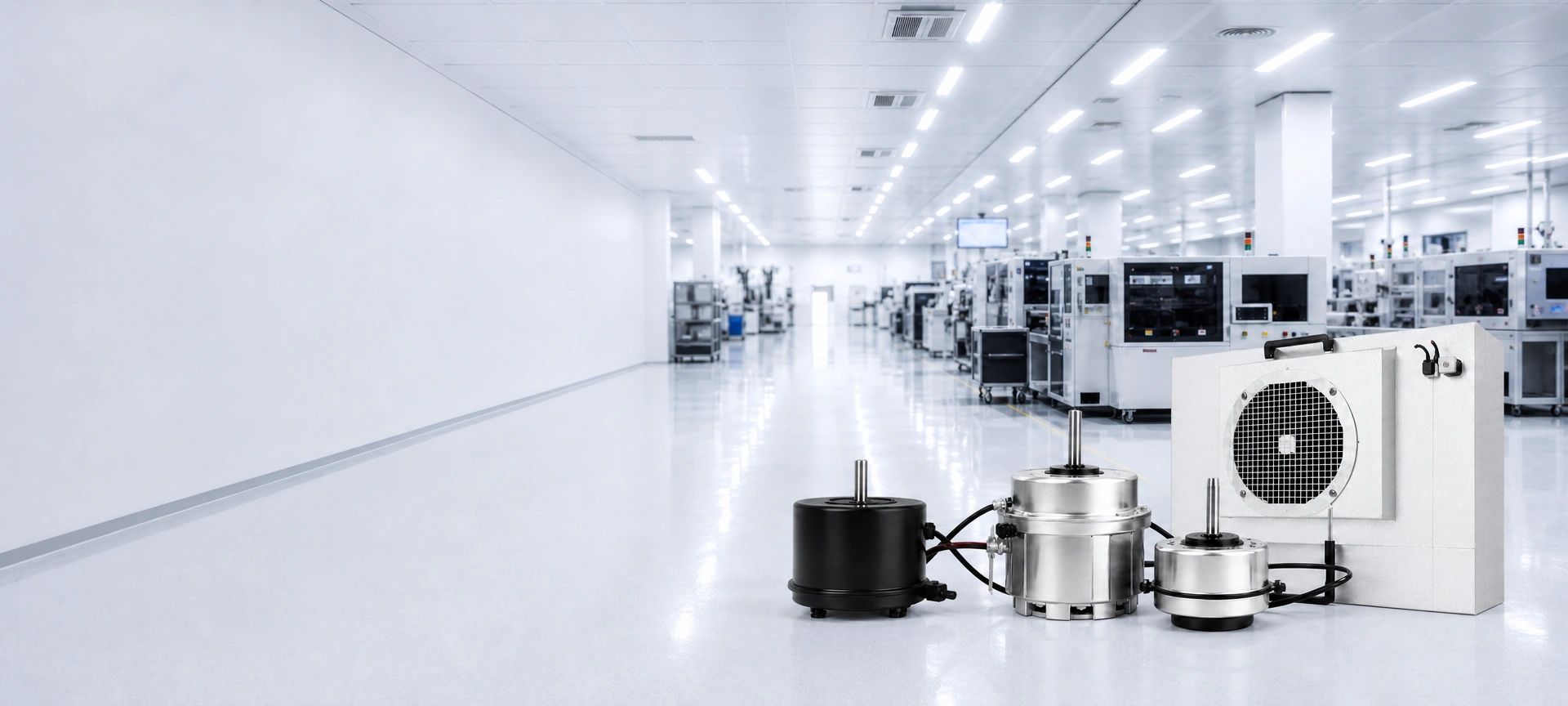
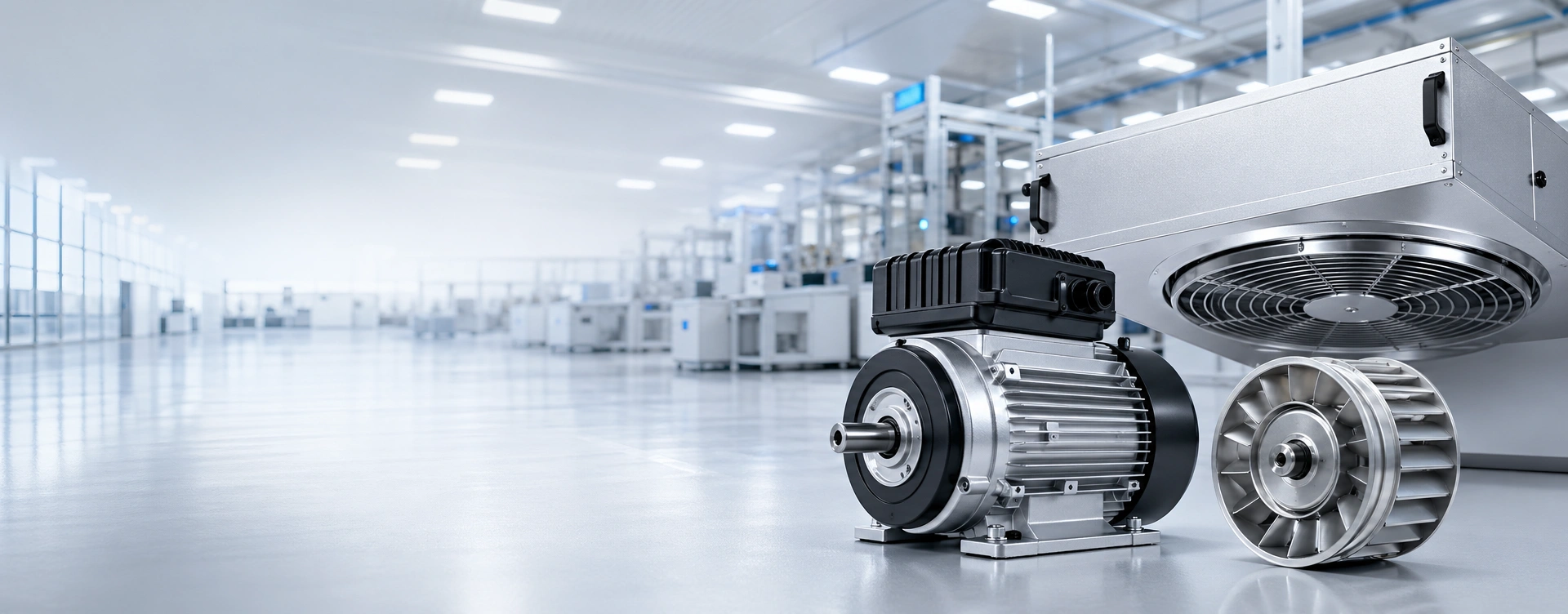
Core FFU Component Manufacturer
Focus on Clean Power

Professional manufacturer of core FFU components. Focused on clean power technology, we deliver high-precision, stable and reliable cleanroom power solutions for global industrial purification scenarios.

  • Fan Filter Unit EC FFU
  • CE、RoHS、3C
  • OEM/ODM · R&D
  • RoHS
  • CE Cert
  • 3C
  • ISO 9001

Core FFU Component Manufacturer
Focus on Clean Power

We specialize in the R&D and in-house manufacturing of core FFU components, focusing on clean power system innovation. With full-chain precision manufacturing capability, we produce low-noise, energy-saving and high-efficiency cleanroom components. Custom OEM & ODM services are available to serve global clients in semiconductor, electronics, pharmaceutical and clean engineering industries.

  • Fan Filter Unit EC FFU
  • CE、RoHS、3C
  • OEM/ODM · R&D
  • RoHS
  • CE Cert
  • 3C
  • ISO 9001

Product Showcase

From core motor components to complete FFU units, providing full industrial chain products

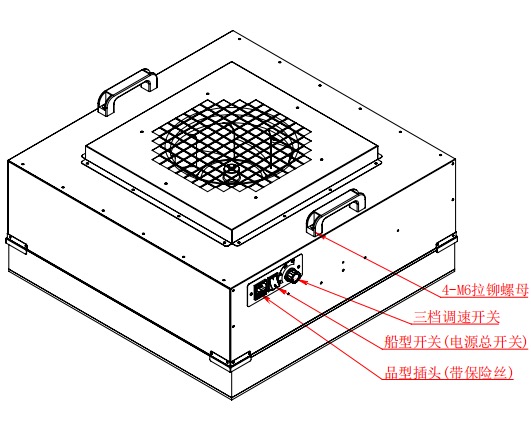
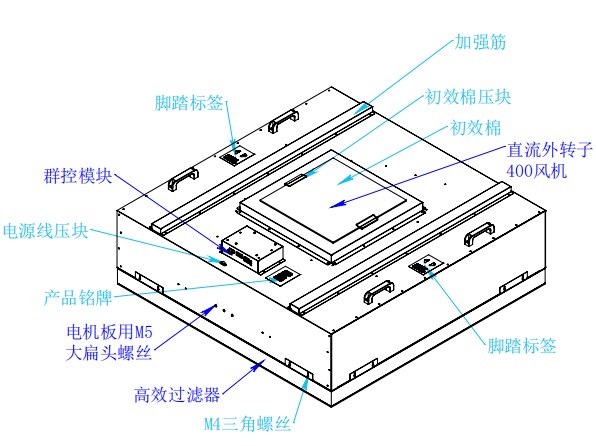
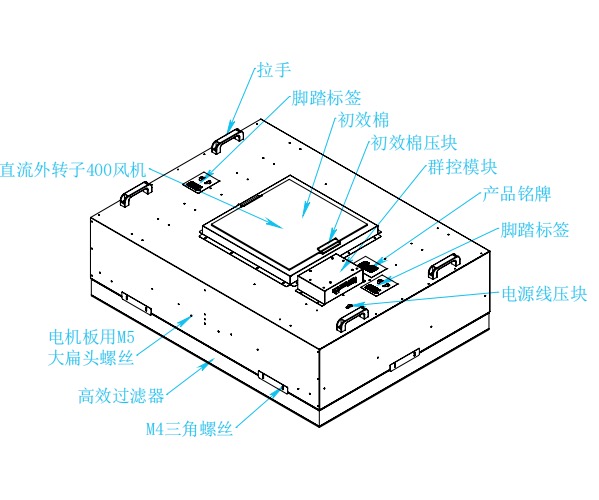
FFU Fan Filter Unit 1175×575 Cleanroom Ceiling FFU with DC 310 External Rotor Fan

This FFU (Fan Filter Unit) is an air purification device designed for cleanroom ceiling systems. It integrates a fan and a high-efficiency filter to provide stable laminar airflow. Air is drawn in by the fan, filtered through a high-efficiency filter, and then supplied evenly into the cleanroom.The unit is equipped with a DC 310 external rotor fan, ensuring stable operation, low noise and uniform airflow. The housing is made of 0.8 mm galvanized steel, providing durable and reliable structure. It is widely used in electronics, semiconductor manufacturing, pharmaceutical workshops and laboratories.
[Why Choose Us]{.b-line}

Why Choose Us

Senter Motor, as a top motor manufacturer in China, offers diversified choices and customized services, backed by a perfect service team. Furthermore, we have been committed to contributing to global environmental protection. Years of technological advancements have ensured Senter Motor's position as a professional core motor manufacturer, and have helped us develop into a large enterprise integrating the research, development, production, sales, and after-sales service of EC motors, DC motors, FFUs, and core components of FFUs.

Source Factory

Independent production from core motor to final assembly, strict quality control

Precision Manufacturing

Advanced automated production lines and testing equipment ensure consistency.

Premium Service

One-stop service from selection consultation to after-sales support.
FAQ

Frequently Asked Questions

An FFU (Fan Filter Unit) is a self-contained cleanroom ceiling module that combines a fan, motor, and HEPA/ULPA filter to supply filtered laminar airflow into a controlled space.

In cleanroom design, FFUs sit in the ceiling grid, draw air from the plenum (or return path), remove airborne particles through a high-efficiency filter, and deliver a uniform downward air curtain. Compared with a central AHU-only approach, modular FFUs scale by zone: facilities typically deploy dozens to thousands of units depending on ISO class coverage and air-change targets.

According to ISO cleanroom classification practice, particle concentration limits are defined by airborne particle counts at specified sizes (see ISO 14644-1). FFUs are one of the primary tools used to maintain those limits at the work plane.

ISO 14644-1 defines cleanroom classes by maximum allowable concentrations of airborne particles — making controlled supply airflow (commonly via FFU arrays) a core engineering control.
— ISO 14644-1:2015, Cleanrooms and associated controlled environments — Part 1: Classification of air cleanliness by particle concentration

Choose FFU size by matching your ceiling grid module first, then validate airflow (m³/h), housing height, motor type, and filter face velocity — not by catalog popularity alone.

Common metric modules include 1175×575, 1175×875, 1175×1175, and 615×615 (often paired with 600×600 or 1200×1200 grid systems). A practical selection sequence:

  1. Confirm grid opening / module size
  2. Set target airflow and face velocity for the ISO class
  3. Check available ceiling depth for fan + filter stack
  4. Select AC vs EC/DC motor and control interface
  5. Confirm filter grade (HEPA H13/H14 or ULPA) and final pressure drop

As a typical planning range, ISO 5 spaces may require 60–100% ceiling coverage, while ISO 7 often needs only about 25–40% — so size choice and quantity are coupled decisions. Verify the final layout against ACH and process particle generation.

For continuously running FFU fleets, EC/DC motors are usually the better lifecycle choice because they deliver higher part-load efficiency, stepless speed control, and easier group control — often cutting energy use by roughly 40–50% versus conventional AC at comparable duty.

AC FFUs can still fit small rooms or tight CapEx budgets. EC/DC becomes compelling when you operate 50+ units for 16+ hours/day: as a rough planning estimate, payback typically falls around 2–3 years from energy and maintenance savings — the actual figure depends on duty-point watts and your local tariff — while group control also enables per-unit speed adjustment.

EC motors keep higher efficiency at part load and support 0–10 V / Modbus-style interfaces for BMS integration.

Estimate FFU quantity from either (A) required air changes per hour (ACH) or (B) ceiling coverage ratio for the target ISO class, then divide total required airflow by the selected unit’s rated airflow.

Method A (ACH):
Total airflow (m³/h) = Room volume (m³) × ACH
FFU count ≈ Total airflow ÷ Unit airflow (m³/h)
Then add margin for filter loading, leakage, and balancing.

Method B (coverage): Use class-based ceiling coverage (e.g., higher classes need denser FFU packing). Typical planning starting points are ~60–100% coverage for ISO 5 and ~25–40% for ISO 7 — always verify against process particle generation and measured validation.

Use HEPA (typically H13/H14) for most ISO 5–8 cleanroom FFUs; choose ULPA when the process demands higher collection efficiency on smaller particles (common in advanced semiconductor / critical optics workflows).

Under EN 1822 filter classification, HEPA and ULPA grades are defined by integral and local efficiency against a most penetrating particle size (MPPS). In practical FFU pairing, HEPA H13 (≥99.95% per EN 1822) is a common choice for broader electronics/food/ISO mid-range use, while tighter processes move to H14 or ULPA — always confirming that the fan can overcome the filter’s initial and final pressure drop.

Selecting a higher filter grade without checking static pressure is a common cause of low airflow and noise complaints.

EN 1822 specifies EPA/HEPA/ULPA classification based on filtration performance at MPPS (most penetrating particle size).
— EN 1822

FFU group control is a networked system that monitors and adjusts many FFUs from a central interface — typically via RS485/Modbus or equivalent — so airflow can be balanced by zone instead of with manual per-unit dials.

For large arrays, group control reduces commissioning time, enables night-setback energy modes, and supports faster response when filters load or zones change duty. EC/DC FFUs pair especially well because speed can be trimmed continuously. Facilities with 50+ units often treat group control as part of the energy payback case, not an optional accessory.

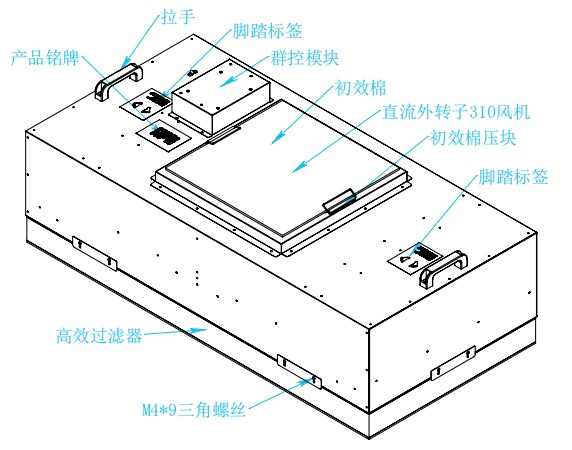
Selected Senter large-format DC FFUs can be supplied with group-control modules for project integration.

External-rotor fans are widely used in FFUs because they deliver high airflow in a shallow package with favorable noise and efficiency characteristics for ceiling modules.

In an external-rotor design, the rotor spins around a stationary stator, enabling a compact motor-impeller assembly that fits limited FFU housing height (often critical under cleanroom ceilings). Senter’s DC 310 and 400 external-rotor platforms target common cleanroom modules where stable laminar supply and low acoustic impact are required. Internal-rotor + aluminum impeller designs remain useful for specific 600×600 grids and duty points — selection should follow the fan curve at the filter final pressure drop, not motor marketing labels alone.

For international cleanroom equipment buyers, prioritize CE and RoHS compliance for market access, and treat ISO 9001 as evidence of a controlled quality system; for China domestic channels, 3C may also apply to applicable electrical products.

Certifications do not replace performance validation (airflow, noise, filter integrity), but they reduce procurement risk in cross-border OEM/ODM projects. Ask suppliers to map certificates to the exact SKU (motor + complete FFU), not only to a corporate brochure.

Senter Motor positions its FFU portfolio around CE, RoHS, 3C (where applicable), and ISO 9001 manufacturing discipline for global clean-power customers.

Product compliance frameworks such as the EU CE marking regime and RoHS substance restrictions are standard buyer filters for electrical equipment entering regulated markets; quality-management certification (ISO 9001) is commonly required in industrial RFQs as a process control signal.
— EU CE / RoHS; ISO 9001

Send the full duty point and constraints together: module size, airflow, initial/final filter pressure drop, voltage, noise target, control protocol, quantity, and any housing/branding requirements.

Neither a fan curve nor a housing drawing is enough on its own — send both, with the final filter pressure drop. Including filter datasheets cuts clarification loops dramatically.

Information needed Why it matters
FFU size / grid opening Mechanical fit
Required airflow (m³/h) Duty point
Initial & final filter ΔP Whether fan can hold airflow as filters load
Filter type / area Resistance & face velocity
Supply voltage Electrical compatibility
Control signal (0–10 V, Modbus…) Group control / BMS
Noise target Acoustic compliance
Quantity & zoning Controls architecture & lead time

Yes — vertically integrated makers that produce FFU core motors/fans and assemble complete units can reduce interface risk, shorten iteration cycles, and stabilize quality from impeller balance to final airflow test.

For OEM/ODM buyers, the practical advantage is one accountable stack: motor platform → fan duty point → housing → filter interface → optional group control. Ask for sample airflow/noise data at the final filter pressure drop, customization boundaries (size, coating, logo, packaging), and export documentation (CE/RoHS mapping).

Senter Motor focuses on clean-power components and finished FFUs for semiconductor, electronics, pharmaceutical, and food cleanroom projects, with OEM/ODM design-manufacturing support.

Looking for High-Quality FFU Solutions?

Whether complete units or custom components, Senter Motor is your trusted partner.
WhatsApp 咨询